Markers give the boldest, flattest color a coloring page can hold. They are also the tool most likely to ruin the page underneath. Choosing coloring books for markers is less about the cover or the theme and more about three quiet details: how the pages are printed, how heavy the paper is, and what you slip behind the page before you start.
This guide explains what makes a coloring book marker-friendly, the honest truth about alcohol markers on ordinary book paper, how to protect the next page, how to test a book before you commit, and how to print your own pages that markers love.
In short
- Single-sided pages matter more than anything else: bleed-through then lands on a blank back, not on another design.
- Always slip a blotter sheet behind the page you are coloring, even in a “marker-friendly” book.
- Alcohol markers bleed through almost any book paper. Plan for it instead of fighting it.
- Water-based markers and gel pens are gentler, but thin paper can still wrinkle, fuzz or ghost.
- Test every marker on the back page or a margin before you color a design you care about.
What makes coloring books good for markers?
A coloring book that suits markers has four qualities. When you shop, check them in this order, because the first one solves the most problems.
- Single-sided pages. Each design is printed on the front of a sheet, with a blank back. Ink that soaks through simply stains blank paper.
- Heavier paper. Thicker paper holds more ink before it reaches the back, and it stays flat when the page is wet.
- A smooth, uncoated surface. Markers glide and blend on smooth paper. Very rough paper drinks ink unevenly and leaves streaks; glossy paper lets ink bead and smear.
- Pages you can separate or lay flat. Perforated pages or a spiral binding let you color on a flat, protected surface instead of fighting the spine.
Most product pages mention the first point; fewer state the paper weight, and almost none describe the surface. Reader reviews that mention a specific kind of marker are often the most useful clue.
Bleed-through vs ghosting vs feathering
These three words get mixed up, but each one has a different cause and a different fix.
| Problem | What you see | Main cause | What helps |
|---|---|---|---|
| Bleed-through | Ink comes out on the back of the sheet | Ink soaks through the fibers | Single-sided pages, blotter sheet |
| Ghosting | A faint shadow of your coloring seen from the back | Paper is thin or translucent | Heavier paper, lighter layers |
| Feathering | Fuzzy edges that spread past the line | Ink wicks sideways along fibers | Smoother paper, less ink at edges |
Ghosting is purely cosmetic on a single-sided page, because nobody colors the back. On a double-sided book it is a real problem: the shadow sits right under the next design.
Feathering is the one that changes your finished picture. If a book feathers with a marker, use that marker only for large open shapes and switch to a fine tip or a colored pencil near the lines.
Single-sided pages: the feature that matters most
If you only remember one thing, remember this: look for “single-sided” or “printed on one side”. It is the difference between a marker accident and a ruined design.
Double-sided books are not useless with markers. Water-based markers, fine liners and gel pens can work well on decent double-sided paper, as long as you color lightly and protect the reverse. But with alcohol markers, a double-sided book almost guarantees that some designs will be stained from behind.
Paper weight for markers, in plain numbers
Paper weight in the US is written in pounds, but text paper and cover paper (cardstock) use different scales, which makes labels confusing. Grams per square meter (gsm) are easier to compare.
| Paper | Approximate weight | How markers behave |
|---|---|---|
| Everyday copy paper | 20 lb bond (about 75 gsm) | Alcohol ink goes straight through; water-based ink may wrinkle |
| Typical book paper | 50 to 60 lb text (about 75 to 90 gsm) | Alcohol ink bleeds; water-based ink usually stays on the front |
| Heavier book paper | 70 to 80 lb text (about 105 to 120 gsm) | Less ghosting; alcohol ink still often reaches the back |
| Light cardstock | 65 lb cover (about 175 gsm) | Good for most markers; alcohol ink may still show behind heavy layers |
| Heavy cardstock | 100 lb cover (about 270 gsm) | Very little bleed; feels like a greeting card |
Many paperback coloring books sit in the “typical book paper” row. That is fine for colored pencils and good for gel pens, but you should expect alcohol markers to come through. Heavier is better for markers, though no paper weight is a perfect guarantee: the amount of ink you lay down matters as much as the sheet.
Alcohol markers vs water-based markers vs gel pens
The kind of ink changes everything. Here is how the three common marker-style tools behave in a coloring book.
Alcohol markers
Alcohol markers carry dye in a fast-drying alcohol solvent. That solvent flows into paper fibers and through them, which is exactly why alcohol markers blend so smoothly, and why they bleed. On standard book paper, assume every page will bleed to the back. Single-sided pages and a blotter sheet are not optional extras here; they are the plan.
They reward a light touch. Color in small sections, keep the area wet while you blend, and avoid going over the same spot again and again. Each extra pass pushes more ink to the back.
Water-based markers and brush pens
Water-based markers, including the washable markers made for children, bleed far less than alcohol markers. Their weak spots are different: on thin paper they can wrinkle the sheet, roughen the surface into fuzzy little balls if you scrub, and leave visible stripes where strokes overlap. Let each layer dry before adding another, and color in one direction.
Gel pens
Gel ink sits mostly on the surface of the paper, so gel pens rarely bleed through a coloring book. They need smooth paper and drying time instead. Our guide to coloring with gel pens covers strokes, smudging and drying in detail. Bright and metallic gel inks also shine on dark or black backgrounds, which is why some books for gel pens print designs on black.
“Bleed-proof” is a promise about paper, not about you
Even paper sold as marker paper can show ink on the back if you saturate one spot. The label means the sheet resists bleed in normal use, not that it is waterproof.
How to protect the next page
Whatever the book, protect what sits behind your page. These habits take seconds and save whole designs.
Set up a page for markers
- Slip a blotter sheet behind the page. A sheet of cardstock or a clear plastic sheet catches any ink that comes through.
- Check the blotter often. When it is stained, move it or replace it, since a wet blotter can transfer ink back onto the next page.
- Remove the page if you can. Tear along the perforation, or cut close to the spine with scissors, and color on a flat table.
- Keep your hand off wet ink. Work from left to right and top to bottom if you are right-handed (the reverse if you are left-handed), or rest your hand on a scrap sheet.
- Let the page dry before closing the book. Give alcohol ink a few minutes and gel ink longer, then close the book or stack the pages.
A blotter also helps with single-sided books. The blank back of the page you are coloring is fine to stain, but the ink can travel onward to the next design if nothing stops it.
Test before you color the good page
Every book and every marker set behaves a little differently, so a two-minute test tells you more than any product page.
- Find a test spot. Use the back page, an inside cover, a copyright page, or a margin near the binding.
- Make a swatch for each marker. One light stroke, then a patch with two or three layers, the way you would really color.
- Wait a minute, then look at the back. Note which markers ghost, which bleed, and which stay clean.
- Check the edges. If a swatch feathers past its edge, keep that marker away from fine lines.
Tip
Write the result next to each swatch: “OK”, “ghosts”, “bleeds”. Next time you open the book, you will know at a glance which markers to reach for and which pages need a blotter.
Coloring with markers in a book that bleeds
Sometimes you already own the book you love, and its paper is thin. You can still use markers with a few adjustments.
- Choose the right designs. Bold designs with larger shapes need fewer passes than tiny, intricate areas.
- Use lighter colors first. Pale shades carry less dye and ghost less; add dark accents last and sparingly.
- Mix tools. Lay a flat marker base in large shapes, then shade and blend with colored pencils on top. Our guide to colored pencil blending explains how.
- Back the page. Some colorists glue a thin sheet of marker paper or cardstock behind a thin page before coloring. Do it only on single-sided pages.
- Fix small accidents. A stray mark or a feathered edge is often rescued with a darker outline or a pattern. See how to fix coloring mistakes.
Mandalas and geometric patterns are especially forgiving here: one slightly darker petal disappears into the repetition. Our mandala coloring guide shows how to plan a palette ring by ring.
How to print your own marker-friendly pages
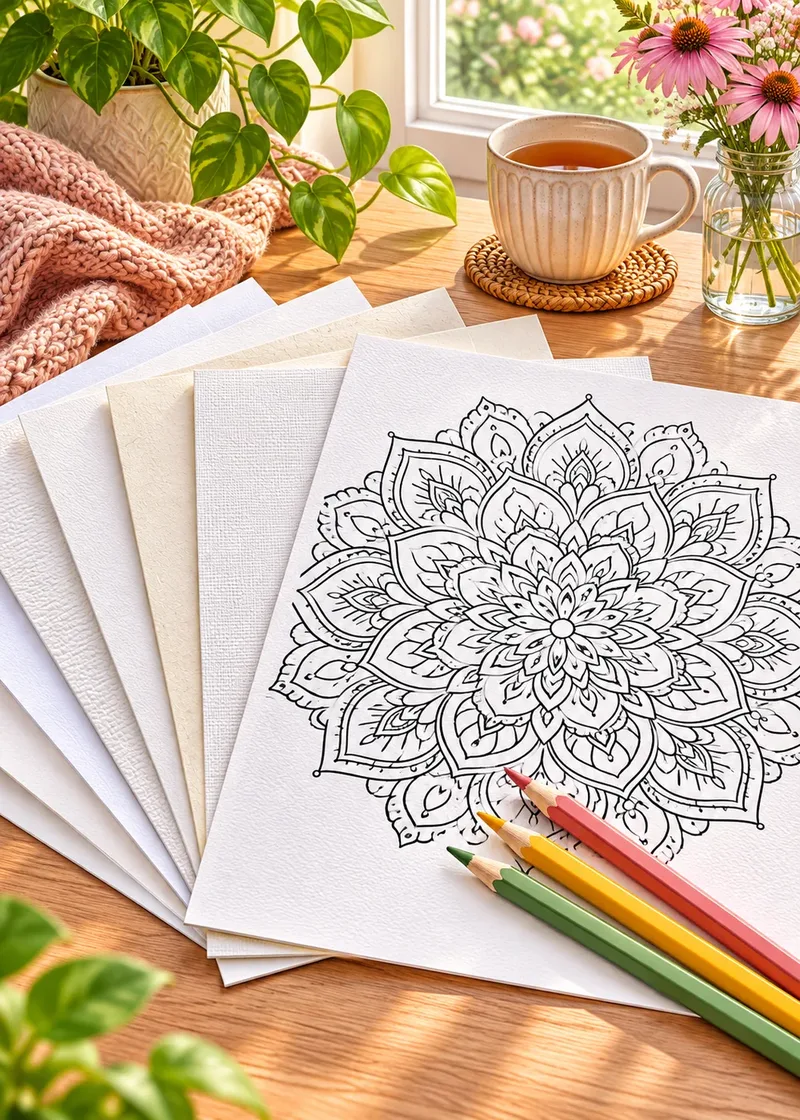
Printable pages solve the marker problem in a simple way: you choose the paper. Print single-sided, always, and pick a smooth cardstock.
- For alcohol markers: smooth 65 lb cover cardstock or heavier, with a blotter sheet underneath.
- For water-based markers: light cardstock keeps the sheet flat while it dries.
- For gel pens: a smooth premium copy paper or cardstock lets the ink sit cleanly on top.
Check the heaviest paper your printer accepts before you buy a pack. Our guide to the best paper for printing coloring pages covers weights, textures and printer settings for crisp, dark lines.
Bold printable designs are great for marker practice. Browse our free printable coloring pages and pick mandalas for flat, repeating shapes or geometric patterns for clean, open areas. Plan the empty space around your subject, too: our guide on how to color backgrounds helps you decide when to fill it and when to leave it white.
Markers in kids’ coloring books
Children love markers for their bright, fast color, and they usually press harder than adults. Washable water-based markers are the usual choice for kids, and they behave well on most book paper. Single-sided pages still help, because a child who colors one page boldly will not spoil the next design.
When you shop for a child, check the line thickness and page format for their age as well. Our guide to choosing a coloring book for kids walks parents through it, and a stack of single-sided books with a set of markers also makes one of the easiest gifts for colorists of any age.
A quick checklist for choosing coloring books for markers
Before you buy, run through these questions:
- Are the designs printed on one side only?
- Is the paper weight listed, and is it heavier than ordinary book paper?
- Is the paper described as smooth or for markers?
- Are the pages perforated, or is the book spiral-bound?
- Do reviews mention the kind of marker you use?
- Do the designs have shapes large enough for marker tips?
A book that answers “yes” to the first question and most of the others will serve your markers well. Add a blotter sheet and a quick test swatch, and you can color with confidence.
Frequently asked questions
What kind of coloring book is best for alcohol markers?
Choose a book with single-sided pages and the heaviest, smoothest paper you can find. Even then, expect some bleed-through on ordinary book paper and always keep a blotter sheet behind the page.
How do I stop markers from bleeding through a coloring book?
Slip a sheet of cardstock or a clear plastic sheet behind the page, use a light touch with fewer passes, and color in small sections. If the pages are perforated, remove the page and color it on a flat surface.
What is the difference between bleed-through and ghosting?
Bleed-through means ink actually passes through the paper and appears on the back. Ghosting is only a faint shadow of the coloring seen through the sheet, with no ink on the back.
Are single-sided coloring books worth it for markers?
Yes. With single-sided pages, any ink that comes through lands on a blank back instead of another design, which is the main risk with markers.
Can I use gel pens in a regular coloring book?
Usually, yes. Gel ink sits on the surface and rarely bleeds through, but it needs smooth paper and a few minutes to dry before you close the book.
What paper should I use to print coloring pages for markers?
A smooth cardstock of about 65 lb cover is a good start for most markers, printed on one side only. Use a heavier cardstock for alcohol markers and keep a scrap sheet underneath.