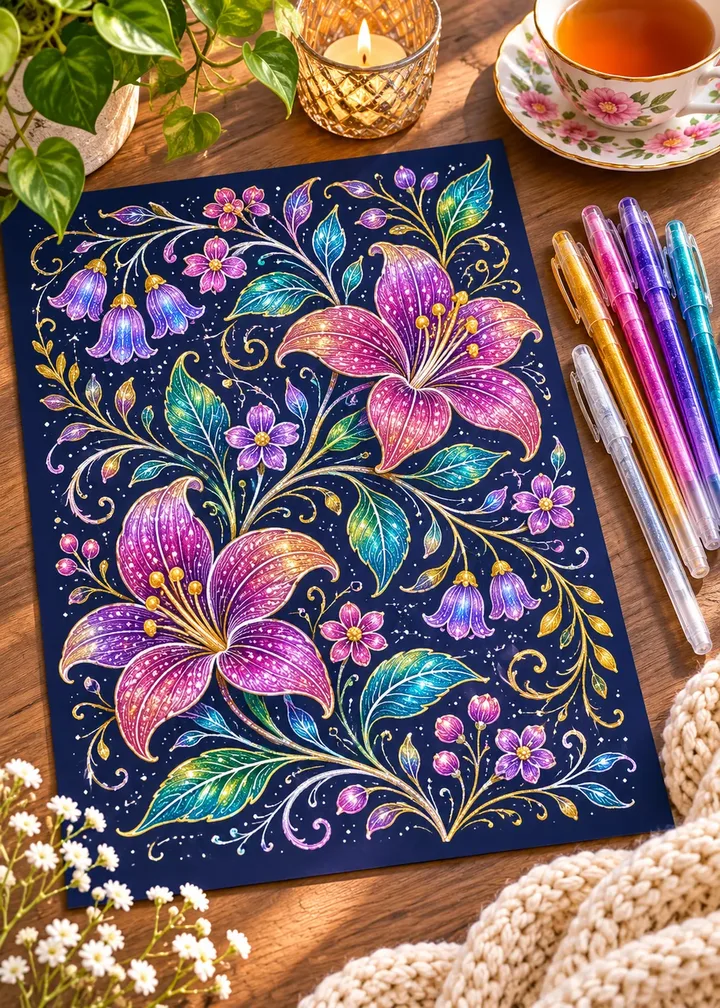
Gel pens bring something to a coloring page that pencils cannot: bold, saturated color that seems to sit on top of the paper and catch the light. Metallic, glitter and pastel inks add even more options. Learning how to color with gel pens takes a little practice, though. Gel ink can streak, smudge, skip or soak through cheap paper, and many people give up after one frustrating page.
With a few habits, gel pens become one of the most enjoyable tools in your kit. This guide covers the paper, strokes and finishing tricks that give smooth, bright results.
In short
- Use smooth, slightly heavier paper and keep a spare sheet underneath.
- Scribble on scrap before each use so the ink flows evenly.
- Outline first, then fill with small, light, overlapping strokes.
- Work away from wet ink and give each area at least a minute to dry.
- Pencil for soft shading, gel for brightness, detail and highlights.
What makes gel pens different
Gel ink is a thick, water-based ink with pigment suspended in a gel. It flows out of a small rolling ball at the tip and stays wet on the surface for a few seconds before it dries. That wet stage is the source of both the beauty and the trouble:
- The ink is opaque or semi-opaque, so it covers well and shows up even on dark colors.
- It dries slowly compared with markers, so it can smear under your hand.
- It does not blend the way pencils do. Two gel colors laid side by side stay mostly separate.
Knowing this changes how you work. Instead of building soft gradients, you plan crisp areas of color, small details and bright accents.
Choose paper that can take the ink
Paper matters more with gel pens than with almost any other tool.
- Smooth paper lets the ball roll evenly and gives the cleanest lines. Very rough paper makes the ink skip.
- Heavier paper holds more ink without curling or showing through. A premium copy paper or a light cardstock is a good choice for printable pages.
- Avoid very glossy paper, where gel ink beads up and takes much longer to dry.
If you print coloring pages at home, the guide to the best paper for printing coloring pages compares common weights. Whatever paper you use, slip a spare sheet underneath your page in case ink comes through.
Start every pen the right way
Gel pens can be fussy at the start of a session, especially if they have been stored for a while.
Before each session
- Scribble on scrap paper. Draw small circles until the ink flows evenly, every time you pick up a pen, not only the first time.
- Wipe the tip gently. A soft tissue removes a blob of ink or a paper fiber caught on the ball.
- Test the color. Gel ink often looks different on paper than through the barrel; make a small swatch on the same paper as your page.
- Cap it right away. Put the cap back on firmly whenever the pen is not in use, so the tip does not dry out.
A pen that starts with a big drop of ink can leave a blot on your page, so that quick test scribble is worth the habit. For storage, follow the instructions on the packaging; keeping caps on tightly matters more than any rule about position.
Why do gel pens skip, and how to fix it
A gel pen that skips or leaves broken lines usually has one of these problems:
| Cause | What you see | Fix |
|---|---|---|
| Dried ink at the tip | Pen starts, then fades | Scribble small circles on scrap until it flows |
| Air bubble in the ink | Sudden gaps in a line | Scribble firmly on scrap; tap the cap end gently on the table |
| Waxy surface underneath | Ink beads or skips over pencil | Add gel before the heavy pencil layers |
| Rough or glossy paper | Patchy, dotted lines | Switch to smooth, uncoated paper |
| Pen held too flat | Thin, scratchy line | Hold the pen more upright |
| Ink running low | Pale, uneven color | Check the barrel; time for a new pen |
If a pen still skips after all of this, set it aside for small dots and accents, where an uneven flow matters less.
Stroke technique for even color
Filling an area with gel ink is more like drawing than coloring. These techniques help avoid streaks:
- Outline first. Trace just inside the edge of the shape, then fill the middle. This keeps edges crisp.
- Use small, overlapping strokes in the same direction, or tiny circles, rather than long back-and-forth scribbles.
- Keep a light, steady pressure. Pressing hard does not add more color, but it can dent the paper and make the ink pool.
- Work in small sections. Gel pens are best for small and medium shapes. For large areas, color the base with pencils and use gel ink on top.
If a shape looks patchy once it dries, wait a minute and go over it once more with the same strokes. A second, thin pass usually evens it out.
Prevent smudges
Smudging is the most common gel pen problem. A few simple habits prevent most of it:
- Plan your direction. Right-handed colorists usually work from left to right and top to bottom; left-handed colorists, the reverse. That way your hand moves away from wet ink.
- Rotate the page as you go instead of reaching over finished areas.
- Rest your hand on a scrap sheet placed over the parts you have already colored.
- Let each area dry for at least a minute before you touch it. Metallic and glitter inks may need longer.
If you do smudge, do not rub it. Let it dry completely, then decide whether to cover it with a darker color or turn it into part of the design. Our guide on how to fix coloring mistakes has more ways to hide a slip.
Can you blend gel pens?
Not the way you blend pencils. Once dry, most gel inks stay put, and rubbing wet ink with a finger only smears it. You can still suggest a gradient:
- Stipple: place dense dots of the darker color at one end of a shape and spread them out toward the other.
- Layer over dry ink: some gel inks accept a second, different color on top once fully dry, for a subtle shift. Test on scrap.
- Water: some gel inks soften with a barely damp brush, others do not move at all. Try it on a swatch before going near your page.
- Pencil on top: the most reliable way to shade a gel area, described below.
Mixing gel pens with colored pencils
Some of the most beautiful pages combine the two tools. Pencils handle soft shading and large areas; gel pens add brightness and detail.
Pencil first, gel on top. This is the most common approach. Color your shapes and gradients with pencils, then add gel details: dots, stripes, outlines, sparkles. Gel ink sits well on top of light pencil layers. Over heavy, waxy pencil, it may bead, so add gel before the final pencil layers if needed.
Gel first, pencil on top. Lay a flat area of gel color, let it dry fully, then shade over it lightly with pencil. This gives vivid color with some depth. Test it on a corner first, since results vary with the ink.
For the pencil side of the process, the guide to colored pencil blending for beginners explains layering and pressure, and the guide on how to shade coloring pages shows where to put the shadows.
Gel pens on dark and black paper
Opaque gel inks are one of the few tools that show up on black paper or over a dark pencil background, which makes them perfect for night skies, glowing flowers and neon patterns.
- Choose opaque inks. White, pastel, metallic and opaque colors show up; regular translucent gel ink nearly vanishes on black.
- Go over twice. One pass can look thin on dark paper; let it dry and add a second.
- Start with white. A layer of white gel under a light color makes it glow.
- Opaque white
#FFFFFFhighlights, stars - Pastel pink
#F6B8D1petals - Pastel mint
#B8EBD6leaves - Pastel yellow
#FBEA9Aglow centers - Metallic gold
#D4AF37small accents
For dark-background ideas, our night sky palettes and the guide on how to color backgrounds pair well with these inks.
Using metallic, glitter and white gel pens
Specialty inks are where gel pens really stand out.
- White gel pens are the secret tool of many colorists. Use them for highlights in eyes, shine on petals, stars in a night sky or patterns on dark areas.
- Metallic inks look best on darker backgrounds and in small amounts: a gold ring on a mandala, silver lines in a wave, copper veins in a leaf.
- Glitter inks are fun for accents but stay slightly raised and need extra drying time. Keep them for the very end.
Treat specialty inks like jewelry
A few touches of metallic, glitter or white look special; too many make the page look busy. Add them last, and step back after each one.
Pages that suit gel pens
Because gel ink shines in small, crisp areas, some designs are a natural fit:
- Patterns and geometric designs with many small, distinct shapes. Our free printable coloring pages are ideal for a first try.
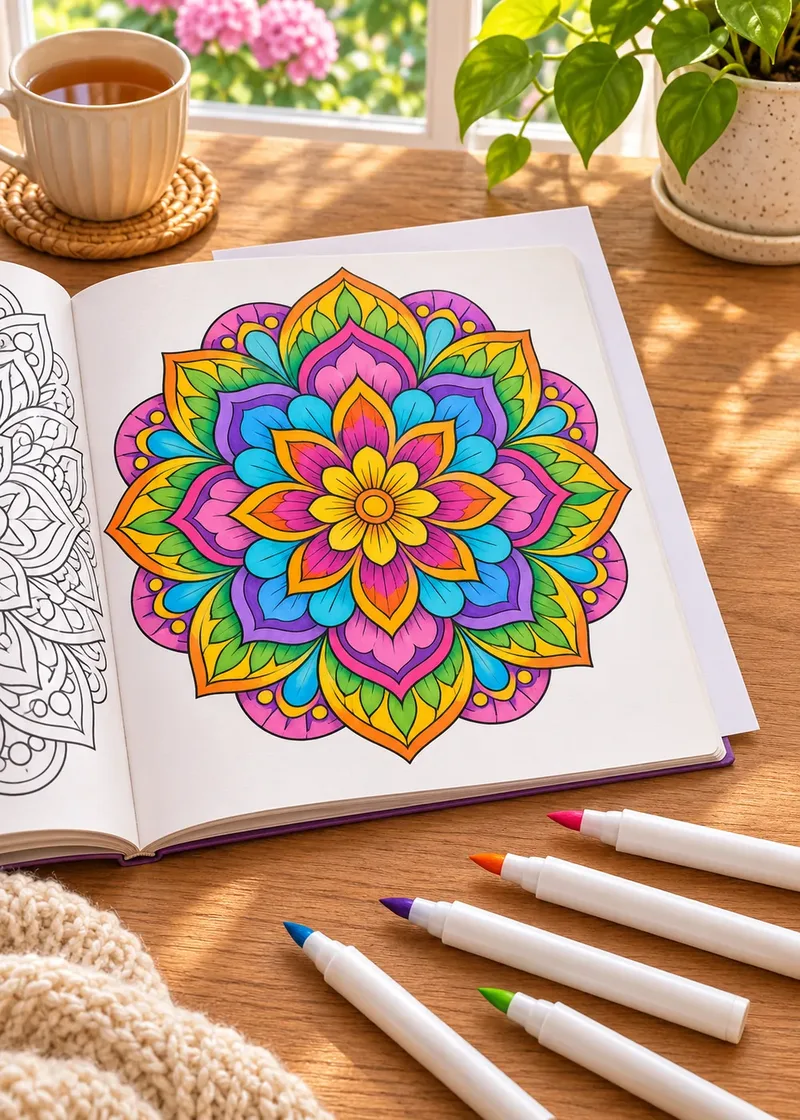
- Mandalas, especially the outer rings full of dots and tiny petals. See how to color mandalas for palettes.
- Designs with bold outlines where a bright color can fill each shape cleanly.
Large, open areas like skies and backgrounds are better handled with pencils or markers, with gel pen highlights on top. If you color in books with gel pens and markers, our guide to coloring books for markers explains what to look for in the paper.
Once you get used to their rhythm, gel pens add a bright, jewel-like finish that makes a coloring page feel complete. Try them on a small pattern page first, and save the sparkle for last.
Frequently asked questions
Why does my gel pen keep skipping?
Usually because ink has dried at the tip, an air bubble has formed, or the surface underneath is waxy or glossy. Scribble small circles on scrap paper, hold the pen more upright, and add gel before heavy pencil layers.
How long does gel pen ink take to dry?
Regular gel ink usually needs about a minute on ordinary paper; metallic and glitter inks and thick layers need longer. Test on the same paper and wait until the shine disappears before touching it.
Can you blend gel pens?
Not like colored pencils. You can suggest a gradient with stippled dots, layer a second color over dry ink, or shade over a dry gel area with colored pencil. Some inks soften with a damp brush; test first.
Do gel pens work on black paper?
Opaque inks do: white, pastel, metallic and specially opaque colors show up well on black or dark pages. Regular translucent gel colors nearly vanish, so test them on a scrap of the same paper.
Do gel pens bleed through coloring books?
Gel ink rarely bleeds the way alcohol markers do, but heavy layers can show through thin paper. Keep a spare sheet behind the page and test on the last page first.
Can you use gel pens over colored pencil?
Yes, over light pencil layers. Over heavy, waxy pencil the ink can bead or skip, so add gel details before the final, firm pencil layers.