Ocean pages look simple at first glance: water is blue, done. Then you start and realize that a sea made of one flat blue looks like a swimming pool painted on a wall. The ocean is never one color. It shifts from pale green to deep navy, reflects the sky, and is full of creatures that need to stand out.
This guide shows how to color water on ocean scenes step by step, then waves, reflections, light rays, fish, coral and sand, with ready palettes to try on your next free ocean coloring page.
In short
- Water is lighter near the surface and darker in the depths.
- Keep wave crests, foam and bubbles white.
- Use warm colors for sea life against the cool water.
- Make distant objects bluer and paler.
- Choose one palette and repeat its accents across the page.
How to color water in layers
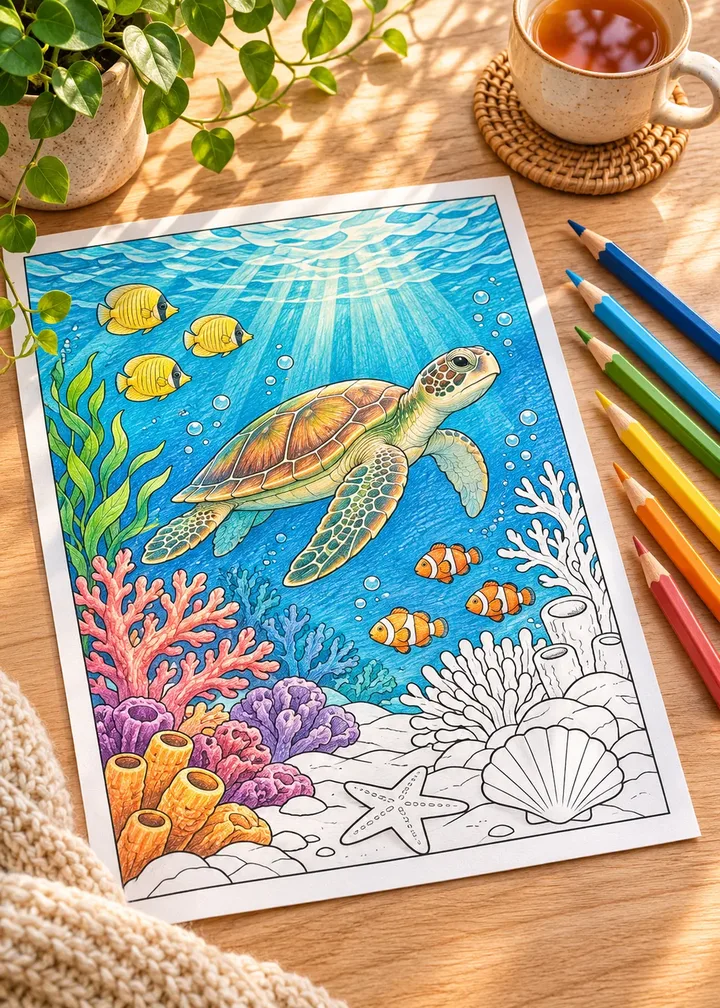
The most useful idea for ocean scenes is depth. Water near the surface lets more light through, so it looks lighter and often greener. Deep water absorbs light and turns dark blue, then almost black.
On an underwater page: light turquoise or aqua at the top, a medium ocean blue in the middle, and navy or blue violet at the bottom and edges. On a page seen from the shore, the logic is horizontal: lighter near the beach, darker toward the horizon.
Building an ocean gradient
- Lay the lightest blue everywhere. Cover the whole water area with light, even pressure.
- Add the medium blue. Work it over the lower two thirds, easing off as you go up.
- Add the darkest blue. Keep it to the bottom band and the corners.
- Blend the joins. Go back over each transition with the lighter color and firm pressure.
If blending is new to you, colored pencil blending for beginners shows the method in detail.
Waves, foam and light on the water
Here the white of the paper becomes your most important color.
- Leave wave crests white or nearly white. Color the body of the wave with blues and greens, darkest in the curl under the crest.
- Foam is a cluster of irregular white shapes. Color around them with light blue or gray so they pop.
- Bubbles and sparkles can be added at the end with a white gel pen. A few well-placed dots look more convincing than a hundred.
How to color reflections and transparent water
Water near the surface works like a soft, broken mirror.
- Reflections of a boat, a rock or the sky sit directly below the object, in slightly darker, duller versions of its colors. Break them into short horizontal strokes with gaps of bare blue between them: the gaps read as ripples.
- Calm water gets longer reflection strokes; choppy water gets shorter, more scattered ones.
- Transparent shallows show what lies beneath. Color the sand or pebbles first, then glaze a light layer of aqua or turquoise over them, lighter pressure at the shoreline.
How to color underwater light rays
Light rays are long, soft stripes that fan out from the surface.
Soft light rays
- Plan the rays. Lightly mark a few slanted bands, all leaning the same way.
- Color around them. Keep the water a touch darker on either side of each band.
- Lighten the rays. Go along them with a white or very pale aqua pencil, firm pressure.
- Fade them out. Let each ray grow softer and narrower toward the bottom.
Make fish and sea life stand out
Sea life needs contrast against the water, and the easiest contrast is temperature. The ocean is a cool space, so warm colors jump forward.
- Use warm accents for creatures: coral, orange, golden yellow, pink and red.
- Keep one or two cool creatures, such as a blue fish or a purple jellyfish, for balance.
- Repeat each accent at least twice. A single orange fish looks lost; three spread out create a path for the eye.
How to color fish scales
Color the fish in its light base first. Then shade each scale slightly darker along its lower curved edge, and darken the whole belly or the side away from the light. A tiny white dot in each eye brings creatures to life. Our guide on how to shade coloring pages explains this kind of form shading in more depth.
Coral, rocks and sand
Coral comes in pink, peach, lilac, ochre and deep red. Shade each branch with two values, lighter on top and darker underneath.
Rocks look natural in gray blues, purples and muted greens rather than plain gray. Darken their lower half where they meet the sand.
How to color sand
Sand is rarely pure yellow. Use a cream base with light touches of tan, a little gray in the shadows under rocks and shells, and small dots of darker tan for texture.
Everything underwater is tinted by the water: distant coral should be bluer and paler than coral in front. A light layer of blue over far objects creates depth.
Five ocean palettes to try
| Mood | Water | Accents | Floor |
|---|---|---|---|
| Tropical lagoon | Aqua, turquoise, teal | Coral, lemon, hot pink | Cream sand, peach |
| Deep sea | Navy, indigo, dark teal | Glowing cyan, lime, violet | Charcoal, deep purple |
| Calm morning | Pale blue, soft green | Peach, rose | Warm beige |
| Stormy sea | Slate blue, gray green | White foam, pale yellow | Dark gray |
| Sunset shore | Blue violet, dusty teal | Orange, magenta, gold | Rose sand, mauve |
Two of them as swatches you can match to your pencils:
- Aqua
#8FE0DAsurface water - Turquoise
#2BB3B1middle water - Teal
#17736Fdepths - Coral
#F2765Afish and coral - Cream sand
#F3E3C3sea floor
- Navy
#142A4Fbackground - Indigo
#2E2A6Bshading - Dark teal
#0F4C52far water - Glowing cyan
#5FE3F0creature edges - Lime
#B6E35Asmall glows
Glowing creatures
On the deep sea palette, color the background very dark first, then keep jellyfish light with a little cyan or lime at their edges. The night sky color palettes use the same trick for stars.
Where to start on the page
- The main creatures in their light base colors, so you do not cover them by mistake.
- The water, light to dark, leaving waves and bubbles white.
- The floor, coral and rocks.
- Shadows and details on creatures, now visible against the water.
- Highlights with a white pencil or gel pen.
Coloring creatures first feels backwards, but it lets you color the water right up to their edges without stray blue lines on an orange fish.
Choosing the right ocean page
Start with a few large creatures and plenty of open water: big shapes are ideal for gradients. Dense reef scenes are rewarding later. If you plan many layers of blue, heavier paper helps; see the best paper for printing coloring pages. For the water around the edges, our guide on how to color backgrounds has more ideas.
Frequently asked questions
What colors do you use to color water?
Use at least three blues or blue greens: a light aqua for the surface, a medium ocean blue, and navy or blue violet for the depths. Leave crests and foam white.
How do you make water look shiny?
Contrast does it. Keep small white or very pale areas next to your darkest blue, and add a few sharp sparkles with a white gel pen at the end.
How do you color water reflections?
Place the reflection below the object in darker, duller versions of its colors, broken into short horizontal strokes with gaps of blue between them.
What color is sand in a coloring page?
Usually cream with touches of tan, plus a little gray in the shadows and darker tan dots for texture, rather than bright yellow.
Should I color the fish or the water first?
Color the main creatures first in light base colors, then the water around them. It is easier to keep their edges clean.