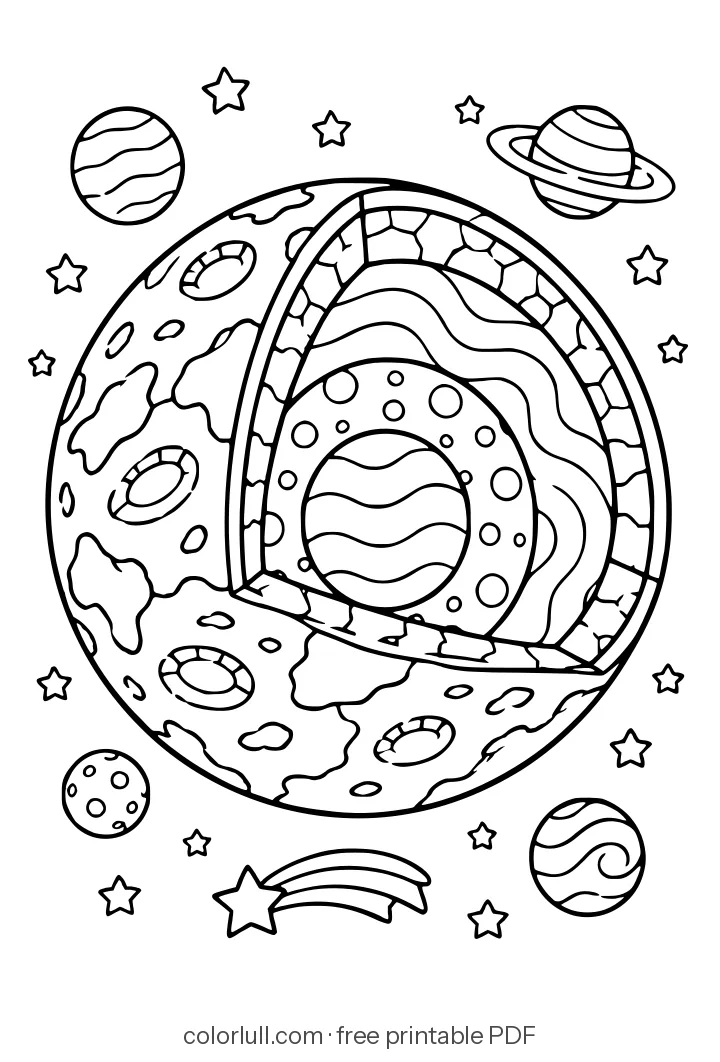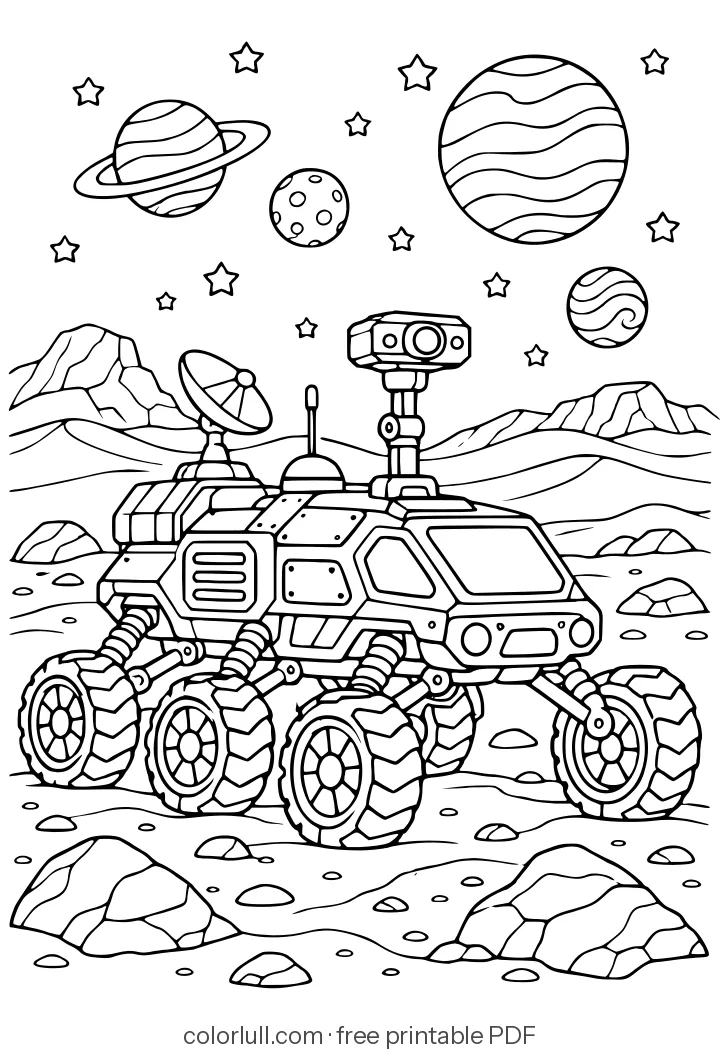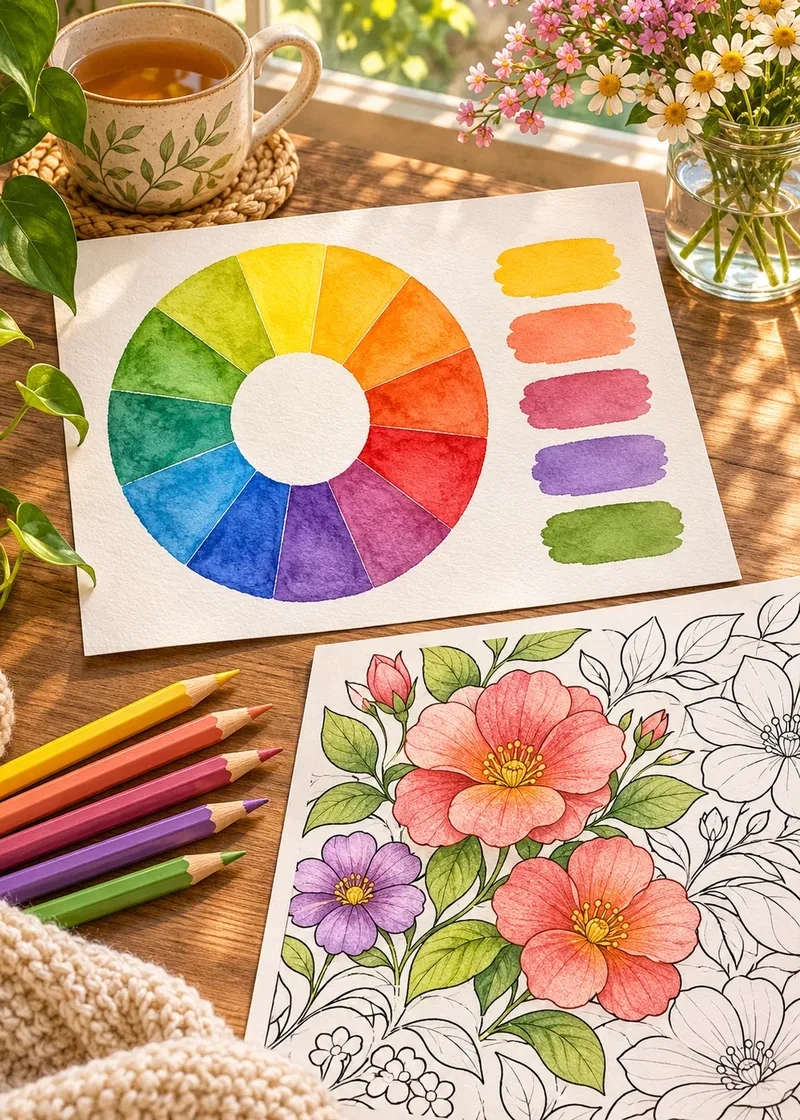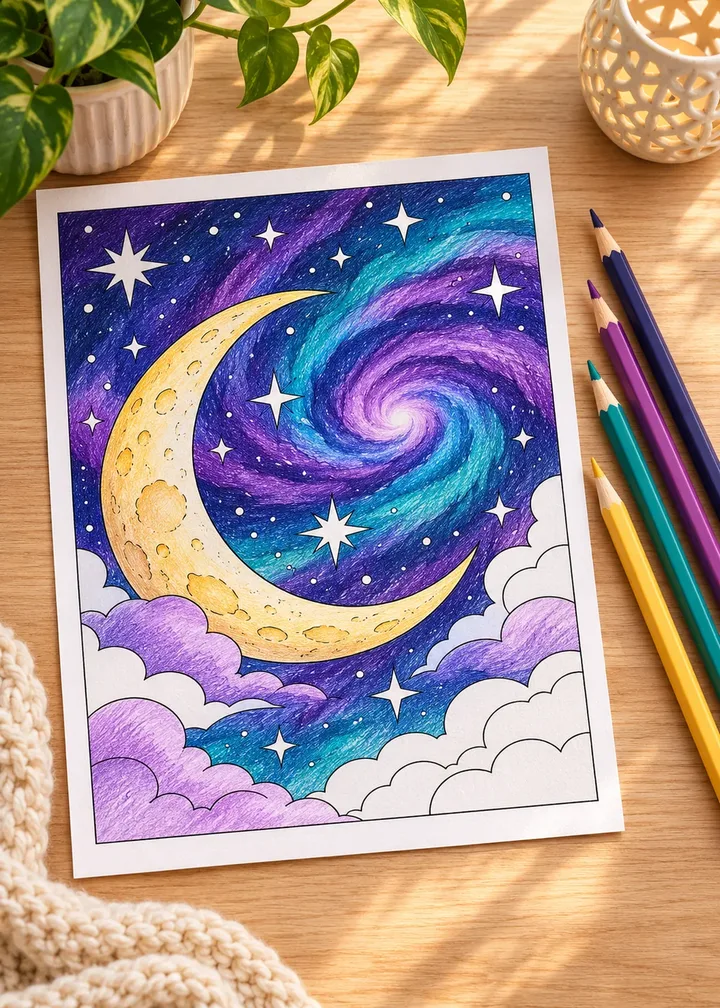
Space scenes are some of the most rewarding pages to color. Planets, crescent moons, swirling galaxies and starry skies give you permission to use deep, saturated color, and a few bright highlights make the whole page glow. They are also a great place to practice long, soft gradients.
Below are seven palettes for galaxy and night sky coloring, a step-by-step method for a blended galaxy, the real colors of the planets, and practical tips for stars, nebulas and dark backgrounds.
In short
- Plan your light source first and keep it consistent.
- Build dark skies with several layered blues and violets, not one heavy layer.
- Leave stars white, add halos, finish with a white gel pen.
- Shade planets away from the light for a round look.
- Reuse these palettes on mandalas, butterflies and cottages at dusk.
Before you start: plan the light
In a night scene, light is precious. Decide early where it comes from: a moon, a bright star, a planet’s glowing edge or the haze of a galaxy core. Everything close to that source stays lighter and warmer; everything far away falls into deep blue, violet or near-black.
Mark the lightest areas very lightly, or keep them in mind, and color around them. Leaving white paper is the easiest way to make stars sparkle.
Seven palettes for night skies and space
1. Classic midnight
The go-to night sky. Start with pale blue near the horizon or around the moon and darken toward the top with indigo and violet. It reads as calm and clear.
- Pale blue
#BFD8F2horizon and moon glow - Cobalt
#2F5DB8lower sky - Ultramarine
#2A3B9Cmiddle sky - Indigo
#23205Eupper sky - Deep violet
#3B1F5Ccorners
2. Aurora glow
Soft curtains of green and pink over a dark sky. Blend mint into emerald in wavy bands, add a hint of magenta at the edges, and surround everything with navy so the colors seem to shine.
- Mint
#A8EBC9brightest bands - Emerald
#1F9E6Eaurora body - Teal
#167A7Asoft edges - Magenta
#C2368Fupper fringe - Deep navy
#101C3Dnight sky
3. Nebula dream
For galaxies and cosmic clouds. Lay pink and orchid in loose, cloud-like patches, let turquoise drift through them, and deepen the outer edges with plum. Keep the center lightest.
- Pink
#F4A6C6galaxy core - Orchid
#C36FC9cloud patches - Violet
#6E3FB0middle clouds - Turquoise
#3FC1C9drifting accents - Dark plum
#2E1438outer edges
4. Desert night
Colors: peach, terracotta, dusty rose, slate blue, charcoal blue. A warm horizon fading into a cool sky, perfect for hills or cacti under the stars. The warm band at the bottom makes the blue above feel deeper.
5. Moonlit silver
Colors: light gray, silver blue, steel blue, deep slate, white highlights. A quiet, almost monochrome palette for crescent moons, clouds and owls on branches. Leave paper bare for the moon’s edge.
6. Planet pop
Colors: golden yellow, orange, coral, teal, deep blue. Warm planets stand out brilliantly against a teal and deep blue background, a favorite for rockets and cartoon planets.
7. Twilight purple
Colors: lavender, lilac, violet, wine, midnight blue. The moment just after sunset: run lavender near the horizon up into violet and midnight blue. Lovely for bedtime-themed pages.
How to color a galaxy step by step
A galaxy is one of the most popular night sky effects, and it is easier than it looks. Use the Nebula dream palette or your own light, middle and dark colors.
A blended galaxy background
- Map the glow. Lightly scribble a diagonal band through the page with your lightest color, keeping its center pale.
- Add loose clouds. With the side of the pencil, lay soft curly patches of pink and orchid along the band.
- Deepen around the band. Work violet, then plum or indigo outward, overlapping each color a little.
- Fill the far sky. Layer two dark colors in small circles until the corners are deep and even.
- Blend the joins. Burnish transitions with a white or light pencil and firm pressure.
- Add the stars. Dot stars in varied sizes with a white gel pen, more of them inside the bright band.
Our guide to colored pencil blending explains layering and burnishing in detail, and how to color backgrounds covers large dark areas on any page.
How to color a smooth night sky
Large dark backgrounds are where colored pencils need patience.
- Use light pressure for the first layers. Build darkness gradually rather than pressing hard once.
- Layer two or three dark colors. Indigo over violet over dark blue gives a richer night than one pencil. Black alone often looks flat; add it last and lightly.
- Work in small circles to avoid visible strokes.
- Fade toward the horizon or the light source, using lighter blues.
Making stars glow
- Leave them white. Color around stars rather than over them.
- Add a halo. Surround bright stars with a soft ring of pale yellow or light blue.
- Use a white gel pen at the end for tiny stars. Vary the size: a few larger dots, many tiny ones.
- Try star bursts. Four thin lines crossing at a bright star, longer vertical than horizontal, give a classic twinkle.
Real planet colors for space coloring pages
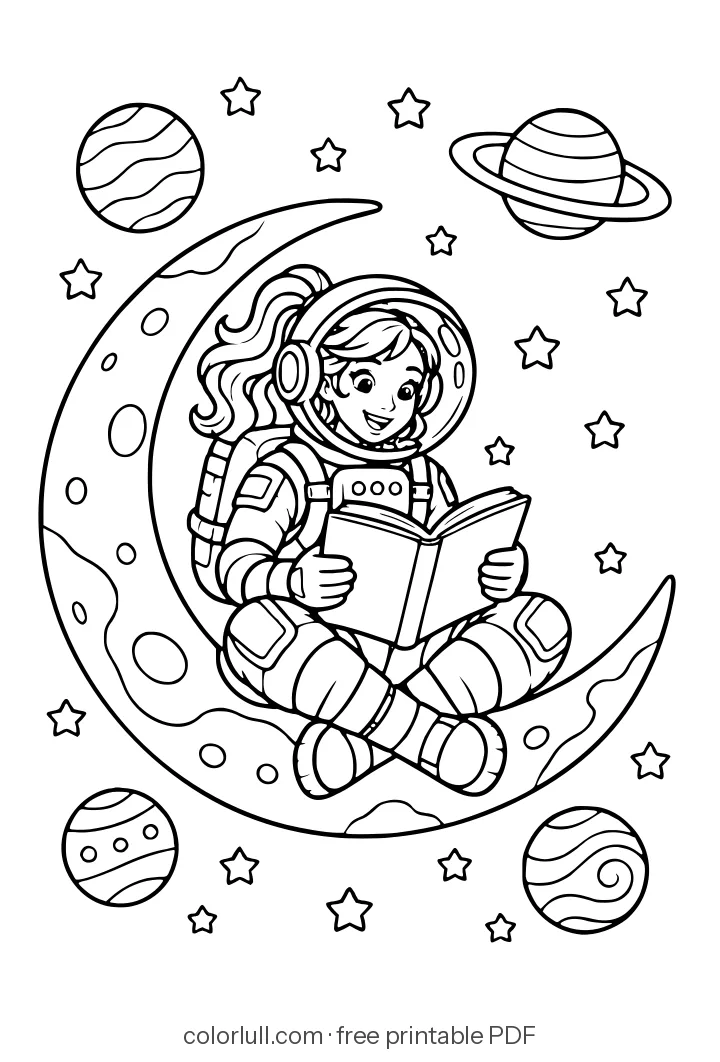
Fantasy colors are always welcome, but if you want planets that look like their photos, these are the colors to aim for:
| Planet | Colors to use | Why it looks that way |
|---|---|---|
| Mercury | Warm gray, light brown gray | Bare rock and dust, no atmosphere to tint it |
| Venus | Pale cream, light yellow | Covered in thick, bright clouds |
| Earth | Ocean blue, green, tan, white | Oceans, land and swirling clouds |
| Mars | Rust, orange brown, tan | Dust rich in iron oxide, a kind of rust |
| Jupiter | Cream, tan, orange brown bands | Cloud bands, plus the reddish Great Red Spot |
| Saturn | Pale gold, butterscotch, beige | Hazy, softly banded clouds and bright rings |
| Uranus | Pale cyan, soft blue green | Methane gas plus a thick haze |
| Neptune | Soft blue, a bit deeper than Uranus | Methane gas with less haze |
To make a planet round, keep the lit side light and warm, shade the far side with a darker version of the same color, then add a touch of the background blue at the very edge. A thin lighter rim on the dark side suggests atmosphere. For moons, add soft gray craters and leave the brightest edge white.
Coloring space with kids
Planets and rockets are a favorite with young colorists, and the planet table above turns any coloring session into a small science lesson. Our space coloring activities for kids gather ideas for families and classrooms.
Markers on night skies
Alcohol markers can give beautifully even dark backgrounds, but they use a lot of ink on large areas and soak through thin paper. Print on smooth cardstock, color in overlapping circles while the ink is still wet, and protect the table with a scrap sheet. See the best paper for printing coloring pages for what to use.
Space palettes on other designs
Try Nebula dream on a mandala, Aurora glow on a butterfly, or Twilight purple on a cozy cottage at dusk. Our guide to coloring mandalas shows how to spread a palette across a circular design, and how to choose a color palette helps you build your own. Ready to start? Browse our free coloring pages.
Frequently asked questions
What colors do you use for a galaxy?
A light core of pink or pale blue, middle tones of orchid, violet and turquoise, and deep plum, indigo or navy for the outer sky, finished with white stars.
How do you color a night sky with colored pencils without streaks?
Build the dark in several light layers of two or three blues and violets, using small circles, then blend the joins with firm pressure.
Should I use black for a night sky?
Black alone tends to look flat. Layer dark blues and violets first and add a little black last, lightly, only in the darkest corners.
How do you make stars stand out?
Leave them as white paper, add a soft pale halo around the brightest ones, and dot tiny extra stars with a white gel pen at the end.
What color is each planet?
Mercury is gray, Venus pale cream, Earth blue and green, Mars rusty orange, Jupiter banded cream and tan, Saturn pale gold, and Uranus and Neptune soft blues.