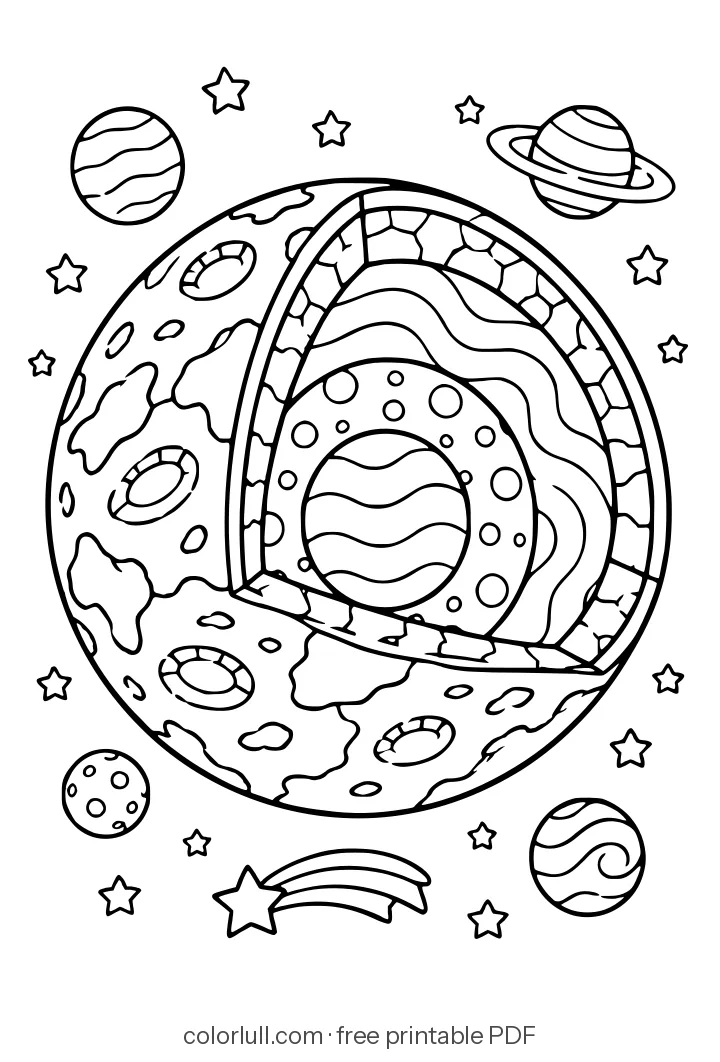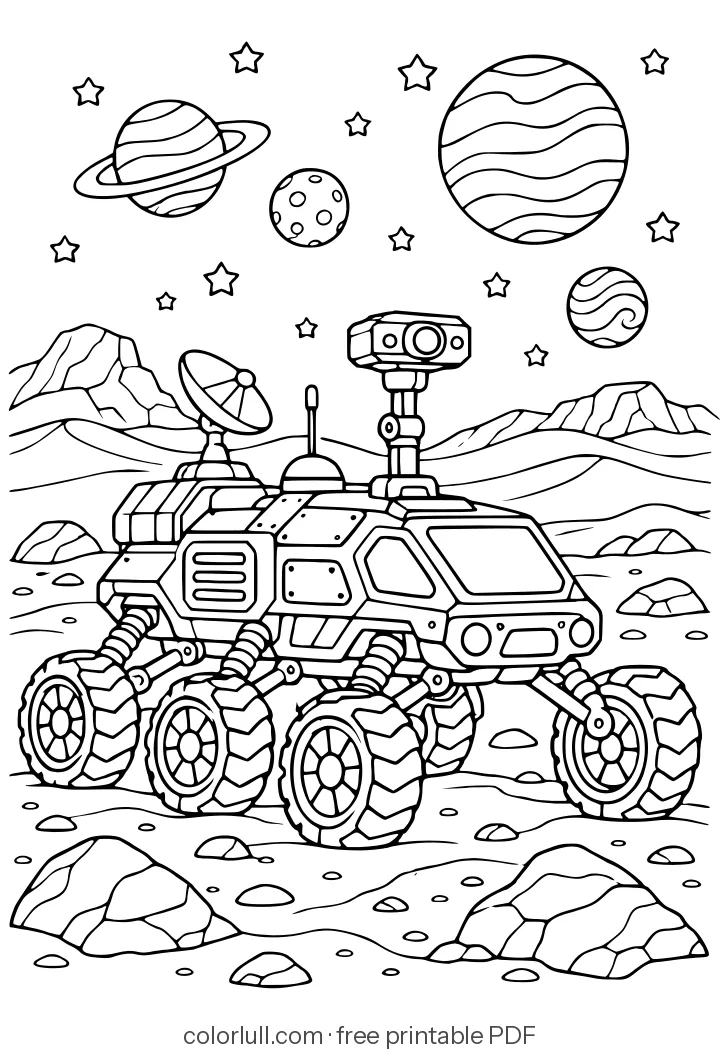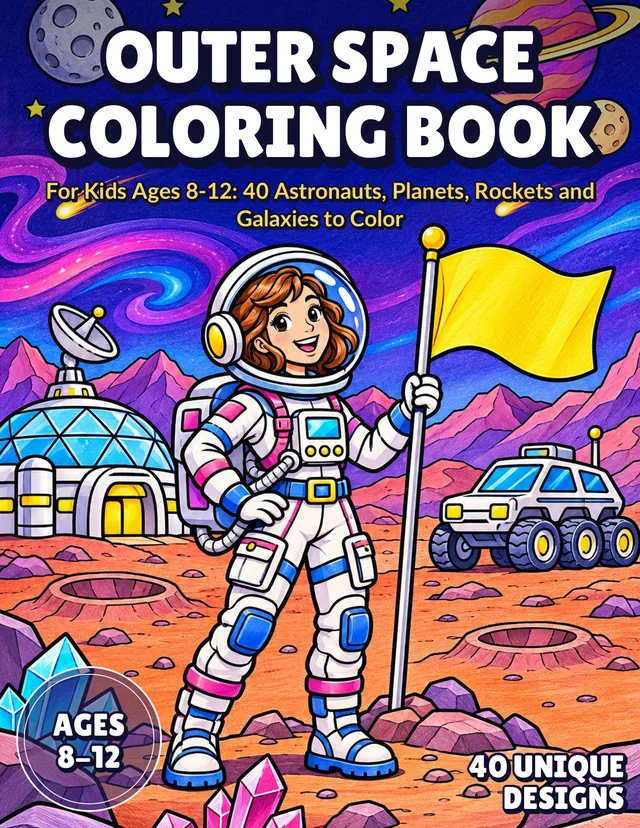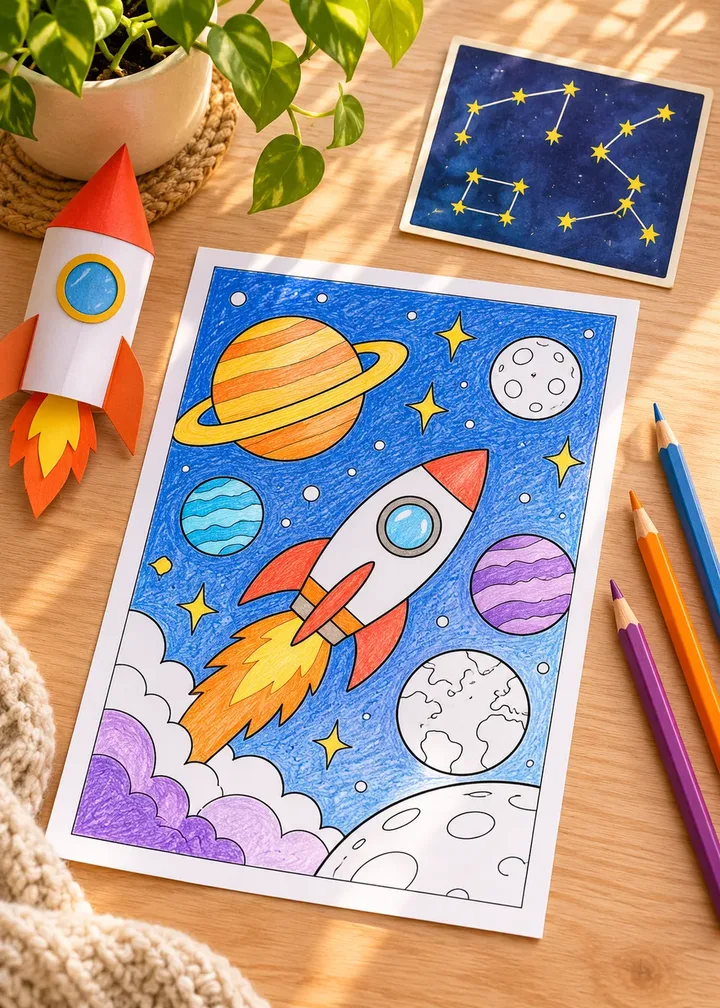
Space coloring pages for kids are more than a quiet-time filler. Paired with a small hands-on activity and one true fact, a page of planets or rockets becomes a little science lesson that children actually remember. This guide is written for parents, teachers and caregivers of kids roughly 6 to 12.
You will find space activities for kids sorted by age, the real colors of the planets with a ready-made palette, a paper solar system you can measure with a ruler, a winter stargazing plan, and a one-week schedule. Almost everything needs only paper, pencils, tape and a flashlight.
In short
- Pair each space coloring page with one hands-on activity and one fact you can check.
- Ages 6 to 8: planets in order, a paper straw rocket, a Moon journal.
- Ages 8 to 12: a solar system to scale, a mission patch, constellation cards.
- Real planet colors are softer than many pictures suggest, and rainbow planets are fine too.
- Winter evenings are a great time to find Orion together.
How do space coloring pages fit into learning?
A simple routine works at home and in class: observe, color, explain. First look at something real together, such as a photo of Jupiter, the Moon outside the window or a diagram of the planets. Then color a page about it. Finally, ask your child to tell you one thing about what they colored.
That last step is the one that sticks: a child who explains “Jupiter has stripes because of its clouds” has connected a fact to something they made.
Coloring as part of a STEM lesson
Scientists sketch and label what they observe, and a coloring page is a friendly first step in the same direction. Ask kids to add labels, arrows or a short caption to their page so it becomes a mini science poster.
Space activities for kids ages 6 to 8
Younger kids do best with short activities and big shapes. Plan 15 to 25 minutes each, coloring included.
1. Color the planets in order
Print a page with all eight planets, or let your child draw eight circles of different sizes along a long strip of paper. Color them in order from the Sun: Mercury, Venus, Earth, Mars, Jupiter, Saturn, Uranus, Neptune.
To help the order stick, make up a silly sentence together using the first letter of each planet. For example: My Very Excited Mouse Just Swam Under Noodles. Kids remember the sentence they invented far better than one they read.
2. Color a rocket, then fly a paper straw rocket
Color a rocket page first, then build a rocket that really flies across the room. You need a sheet of paper, tape, a pencil and a drinking straw slightly thinner than the pencil.
Paper straw rocket
- Roll the body. Wrap a strip of paper about 2 inches wide and 5 inches long around the pencil and tape the seam.
- Close the nose. Slide the tube off, fold the top end over twice and tape it shut so no air escapes.
- Add fins. Cut two or three small paper triangles, color them to match the rocket page and tape them near the open end.
- Fly it. Slide the rocket onto the straw, aim at an open wall away from people, and blow one short, strong puff.
- Test one change. Try longer fins or a shorter body and see which version flies farther.
The last step is the science part: changing one thing at a time and comparing results is exactly how engineers test their designs.
3. Keep a Moon journal
The Moon goes through a full cycle of phases in about 29.5 days. Give your child a sheet with a row of empty circles, one per evening. Each clear night, look at the Moon together and shade the part that is dark, leaving the lit part white. After a few weeks, the circles show the Moon growing from a thin crescent to full and shrinking back again.
Cloudy night? Draw a small cloud in the circle and move on.
Space activities for kids ages 8 to 12
Older kids enjoy numbers, design choices and a bit of challenge. These activities take 30 to 45 minutes.
4. Build the solar system to scale on a paper strip
Most pictures squeeze the planets close together. A paper strip shows how far apart they really are. Tape three sheets of US Letter paper end to end along their long sides to make a strip about 33 inches long. Draw the Sun at one end, then mark each planet using 1 inch for each astronomical unit (the average distance between Earth and the Sun).
| Planet | Average distance from the Sun | Mark it at |
|---|---|---|
| Mercury | 0.39 AU | 0.4 inch |
| Venus | 0.72 AU | 0.7 inch |
| Earth | 1 AU | 1 inch |
| Mars | 1.52 AU | 1.5 inches |
| Jupiter | 5.2 AU | 5.2 inches |
| Saturn | 9.5 AU | 9.5 inches |
| Uranus | 19.2 AU | 19.2 inches |
| Neptune | 30.1 AU | 30.1 inches |
Kids are usually amazed that the four inner planets crowd into the first inch and a half. Let them color a dot for each planet in its real color (see the palette below); at this scale the planets themselves would be far too tiny to see, so the dots are only markers.
5. Design a mission patch
Astronaut crews traditionally design an embroidered patch for each mission, with symbols that tell the mission’s story. Draw a circle or shield shape and ask your child to invent a mission: where is it going, what will it study, how many crew? Then draw and color symbols for it: a planet, a rocket, stars for each crew member, a name around the border.
6. Make constellation cards
Print or draw a constellation pattern on black cardstock and color a soft night-sky border around it. Then poke a hole at each star with a pushpin (an adult should do this for younger kids). In a dark room, hold a flashlight behind the card and the constellation glows on the wall or ceiling. Start with Orion, the Big Dipper and Cassiopeia, three patterns that are easy to recognize.
7. Hold an astronaut day
Spend an afternoon living like a space station crew. The space station circles Earth about every 90 minutes, so the crew sees about 16 sunrises and 16 sunsets every day. Astronauts sleep in sleeping bags fastened to a wall so they do not drift around, and much of their food comes in sealed pouches.
Color an astronaut page (the white suit helps reflect the Sun’s heat), then try a crew habit: eat a snack from a pouch or write a “mission log”.
What color are the planets, really?
Many planet pictures are enhanced or shown in false color to reveal details, so photos do not always agree. Here are colors you can trust for coloring, with one fact per planet to share while you work.
| Planet | Colors to use | One fact to share |
|---|---|---|
| Mercury | gray, brownish gray | The smallest planet, covered in craters like our Moon. |
| Venus | pale yellow, cream | Thick clouds hide its surface and reflect sunlight. |
| Earth | blues, greens, browns, white | The only planet known to have oceans of liquid water on its surface. |
| Mars | rusty orange, red-brown | Its dust is rich in iron oxide, the same family of compounds as rust. |
| Jupiter | cream, tan, orange-brown bands | Its Great Red Spot is a giant storm wider than Earth. |
| Saturn | pale gold, beige rings | Its rings are made mostly of chunks of ice. |
| Uranus | pale blue-green | It spins tipped on its side. |
| Neptune | pale blue, a little deeper than Uranus | Older pictures made it look darker blue than it really is. |
That last point is a fun one for kids. Scientists have re-examined the old spacecraft images and found that Neptune and Uranus are much closer in color than popular pictures suggested, both a pale greenish blue, with Neptune only slightly bluer.
- Sun yellow
#F6C343the Sun - Cratered gray
#8C8378Mercury - Cloud cream
#E8D9A8Venus - Ocean blue
#2E6DB4Earth - Rusty orange
#B5532EMars - Warm tan
#C9A27AJupiter bands - Pale gold
#E3C98BSaturn - Pale aqua
#A6DCDCUranus - Soft blue
#7FB3D5Neptune
These hex values are suggestions to match against your own pencils, not scientific measurements. And if your child wants a purple Mars or a rainbow Saturn, that is a perfectly good page too: art and science can sit side by side. For more color ideas, see our guide on how to choose a color palette.
How to color a planet so it looks round
Flat circles become planets the moment kids add light and shadow. Colored pencils work best; crayons work too.
Make a planet look round
- Pick where the Sun is. Draw a tiny sun in one corner of the page so the light has a clear direction.
- Leave a light patch. Keep the side of the planet facing the sun lighter, or leave a small spot of white paper.
- Shade a crescent. On the opposite side, color a darker crescent along the edge with a deeper version of the same color.
- Curve the bands. On Jupiter and Saturn, draw stripes as gentle curves, not straight lines, so they wrap around the ball.
- Blend the middle. Go over the area between light and dark with the middle color to smooth the change.
Our guide to colored pencil blending for beginners shows how to make those transitions smoother, a skill older kids pick up quickly.
Winter stargazing with kids
Winter is one of the easiest times to start, because it gets dark early in the evening, well before bedtime. Dress warmly, bring a blanket, and plan 15 to 20 minutes outside for younger kids. Binoculars are a nice extra but not needed.
Keep a red light
Eyes need about 20 to 30 minutes to fully adjust to the dark, and one bright screen resets them. Tape red paper or red cellophane over a flashlight to read a sky chart without losing your night vision.
Your first target: Orion. On winter evenings in the United States, look toward the southeast in December, and toward the south by late January, for three bright stars in a short, straight row: Orion’s Belt. Above and to the left of the belt is Betelgeuse, an orange-red star. Below and to the right is Rigel, which looks blue-white. Kids love noticing that stars have different colors.
Then follow the belt down and to the left to reach Sirius, the brightest star in the night sky. Follow it up and to the right to find Aldebaran, another orange star.
Dates to mark this season. The Geminid meteor shower peaks on the night of December 13 to 14, 2026, with a thin crescent Moon that will not wash out the sky. The winter solstice, the longest night of the year in the Northern Hemisphere, falls on December 21, 2026.
Back inside, warm up with a night-sky page. Color the constellation you saw on a dark background and leave the stars as white paper. Our guide to coloring backgrounds shows how to keep a dark sky smooth.
- Midnight blue
#1B2357sky near the top - Indigo
#3B2F7Amiddle of the sky - Soft violet
#6A4C9Cglow near the horizon - Pale star yellow
#F8EFA8warm stars - Star white
#FFFFFFstars left uncolored
For more ideas, browse our night sky and space color palettes, our fall and winter coloring ideas, and the moons and starry flowers among our free coloring pages. Looking for a whole book instead? Here is how to choose a coloring book for a child.
A one-week space plan for home or class
Use this as a five-day mini unit. Each day pairs one coloring page with one activity and one fact.
| Day | Coloring | Activity and fact |
|---|---|---|
| Monday | The eight planets | Invent a planet sentence; Jupiter is the largest planet. |
| Tuesday | A rocket | Fly paper straw rockets; change one thing per test. |
| Wednesday | An astronaut | Astronaut day; the space station sees about 16 sunrises a day. |
| Thursday | A night sky | Constellation cards; Betelgeuse and Rigel are different colors. |
| Friday | A free choice page | Solar system strip; Neptune is about 30 times farther from the Sun than Earth. |
Keep every finished page in a folder and let your child present their “space portfolio” on Friday.
Where to find more space coloring pages for kids
Start with our free printable coloring pages, ready to print on US Letter paper. Printing on slightly heavier paper helps if your child presses hard or uses markers; our guide to the best paper for printing coloring pages explains the options.
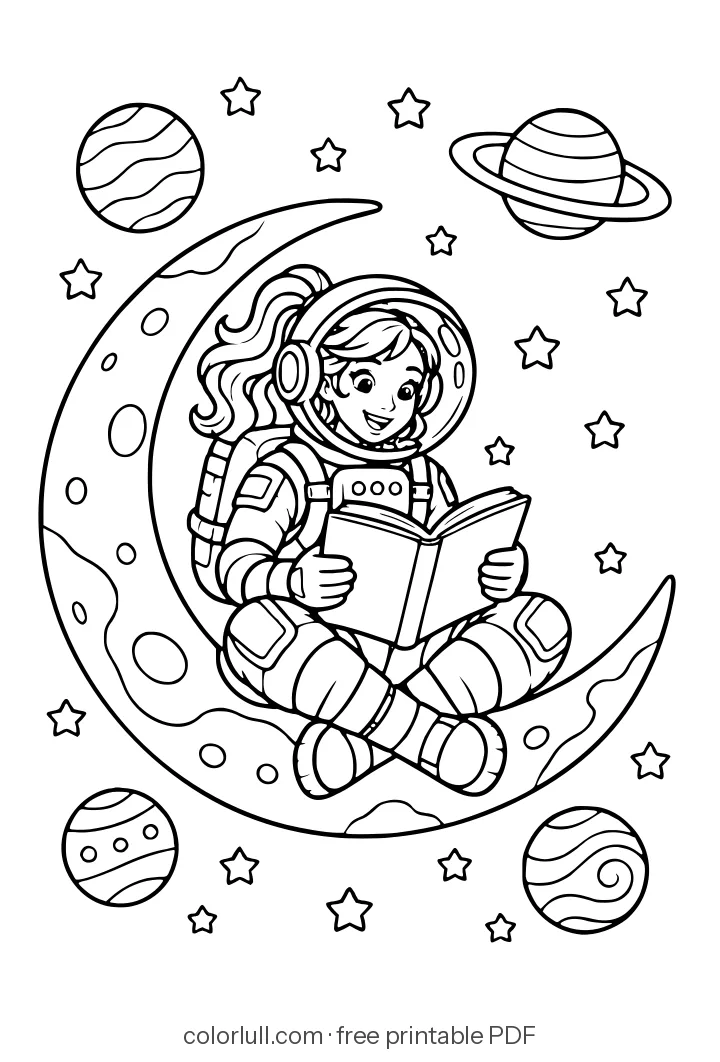
National space agencies also publish free education pages for families and teachers, with photos, fact sheets and classroom activities. They are a great place to check a fact before sharing it.
You can see all our titles on the ColorLull books page.
Frequently asked questions
What are good space activities for an 8-year-old?
At 8, kids enjoy activities with a clear result: a paper straw rocket, constellation cards lit by a flashlight, or a solar system strip measured with a ruler. Pair each one with a space coloring page and a single fact to explain.
How do you teach kids the order of the planets?
Color the planets in order on a long strip of paper, then invent a silly sentence together using the first letters: M, V, E, M, J, S, U, N. A sentence your child made up is much easier to remember.
Can coloring be part of a STEM lesson?
Yes. Use the observe, color, explain routine: look at a real image, color a page about it, then have your child label it or explain one fact. The page becomes a small science poster.
What space activities need no special supplies?
Planet coloring, a Moon journal, a mission patch and a paper straw rocket all use paper, pencils, tape and a drinking straw. Constellation cards add only a pushpin and a flashlight.
What is the easiest constellation for kids to find in winter?
Orion. Look for three bright stars in a short straight row, Orion’s Belt, then find orange-red Betelgeuse above it and blue-white Rigel below it.